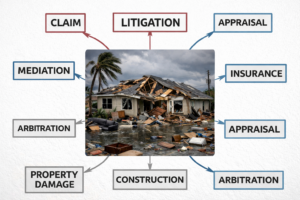
Florida’s first-party property litigation landscape has changed dramatically over the past few years. Pre-suit requirements are stricter, fee shifting has almost disappeared and summary judgment is elusive at best. These changes have altered one central question: When is the right time to mediate? Unfortunately, there is no universal answer. Timing now depends on leverage, risk tolerance, and how fully the factual record has developed.
Mediation Before Appraisal
In disputes where coverage is admitted but scope and pricing are contested, early mediation can still work. Particularly where both sides recognize that appraisal is inevitable, mediation can frame parameters and narrow issues before additional costs are incurred.
However, when causation is disputed, appraisal may not resolve the true conflict. As clarified in Johnson v. Nationwide Mutual Insurance Co., 828 So. 2d 1021 (Fla. 2002), coverage issues remain judicial questions. Mediation before those issues crystallize may result in positional bargaining rather than a meaningful risk analysis that could lead to settlement.
Strategic takeaway: Early mediation works best when the dispute is economic, not legal.
The DFS Mediation Program: An inexpensive and commonly misunderstood option
Florida’s Department of Financial Services administers a voluntary mediation program under §627.7015 for personal lines and commercial residential property insurance claims. It is available before appraisal or litigation, the insurer bears the cost, and insurers are required to notify policyholders of the program when a claim is filed. DFS mediation under §627.7015 is a voluntary option. What is mandatory is the pre-suit notice of intent to initiate litigation under §627.70152, which requires the claimant to file a notice with the DFS at least 10 business days before filing suit. A recent case notes that this notice of intent can also be retroactive. See generally Universal Property and Casualty v. Griffin, 51 Fla. L. Weekly D352B (4th DCA 2026). The insurer must respond in writing within that window, either with a settlement offer or a demand for appraisal. That is a notice-and-response requirement, not a mediation requirement.
The distinction matters strategically. In a DFS Mediation, if a settlement is reached, the policyholder has three business days to rescind assuming certain parameters are met. But the process is informal, conducted through DFS-appointed mediators, and designed to resolve disputes without adversarial proceedings. For straightforward scope-and-pricing disputes, particularly in personal residential claims, it can produce early resolution at minimal cost.
However, DFS mediation usually occurs before the factual record has been fully developed. There are usually no depositions, expert reports, and no litigation pressure driving the insurer’s evaluation. For complex claims or disputes involving causation, the program often lacks the information density needed for meaningful negotiation or resolution.
Strategic takeaway: DFS mediation is a useful early option for straightforward disputes, but counsel should not confuse it with a pre-suit requirement or treat it as a substitute for litigation-stage mediation in complex cases.
Mediation After Key Depositions
Adjuster, expert, corporate representative and claimant depositions frequently shift settlement value. When testimony clarifies claim handling decisions or exposes weaknesses in expert opinions, parties can reassess risk. Under Florida’s alignment with the federal summary judgment standard FRCP 1.510, trial risk has increased. A well-timed mediation after fact depositions but before expensive expert discovery often produces the most rational evaluation.
Strategic takeaway: Mediate when uncertainty narrows but before costs escalate.
Mediation During the Civil Remedy Notice Period
Section 624.155(3)(d) creates a 60-day cure window. As explained in Talat Enterprises, Inc. v. Aetna Casualty & Surety Co., 753 So. 2d 1278 (Fla. 2000), the insurer’s payment of contractual damages within that window can preclude a statutory bad faith action. Mediation during this window can be powerful. It allows both sides to explore resolution without committing to entrenched litigation strategy.
Strategic takeaway: CRN-period mediations require a fully developed factual presentation.
Post-Summary Judgment Hearing
The 2021 summary judgment standard has increased judicial willingness to resolve coverage disputes pre-trial. A pending dispositive motion often creates the sharpest settlement clarity. If the ruling defines the case’s trajectory, mediation immediately before the hearing can avoid unnecessary appellate risk. If the ruling will likely deny relief, mediation immediately can recalibrate expectations.
Strategic takeaway: Summary judgment deadlines create natural settlement inflection points.
The Economic Reality After Fee Reform
With the repeal of §627.428 through House Bill 837 (2023), both plaintiffs and carriers evaluate cases differently. Without one-way fees, plaintiffs must weigh litigation costs against potential net recovery. Carriers evaluate defense spending against exposure without automatic fee multipliers. This economic shift makes mediation more effective when both sides have concrete budgets and litigation forecasts, not speculative projections.
Strategic takeaway: Both sides need to understand their true economic impacts to make the most of mediation.
The Mediator’s Role in Timing
Timing is not merely procedural; it also has an economic and psychological impact. Early mediations often test credibility and assessment systems. Mid-case mediations test endurance. Late mediations test risk tolerance and trial strategies.
The most productive sessions occur when the parties understand their evidentiary strengths and weaknesses, the legal issues are framed but not conclusively decided, and litigation costs have become real but not yet irretrievable. In today’s Florida property litigation environment, mediation is most effective when it follows strategic development rather than procedural scheduling.
Conclusion
There is no universally “correct” moment to mediate a first-party property case. But there are clearly identifiable leverage points.
- Early for economic disputes.
- Mid-case for factual clarity.
- Pre- or post-summary judgment for legal distinction.
Understanding those phases allows counsel to use mediation not as a docket event, but as a deliberate strategy.