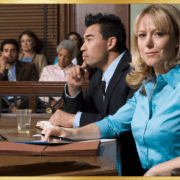
I recently had the good fortune to attend the Hillsborough County Bar Association’s Annual Bench and Bar Conference in early October. Among the many excellent seminars, one stood out to me in particular: a panel of jurors who had served on various civil trials in Hillsborough County. They had returned for the conference to discuss what they had considered important in the trials they had participated in and why they had come to the conclusions they did. As they discussed the observations, evidence and arguments they found most persuasive in reaching their verdicts, I was reminded that success in litigation and trial is as much an art as it is a calculated presentation of the evidence available to counsel and their client. In this two-part blog post, we will explore how nonverbal communication from the attorneys and the parties can influence litigation from the opening stages of a case through to the verdict and the types of evidence juries find most compelling.
Part 1: The Art and Science of Nonverbal Communication
Quick Thinking, Nonverbal Command, and the Advocate’s Presence
When most lawyers think about persuasion in litigation or trial, they focus on arguments, evidence, and the precise words spoken to the Court. But persuasion operates on more than just the conscious, rational level. Body language and subconscious cues influence parties, jurors, and even judges, sometimes more powerfully than a closing argument. Albert Mehrabian’s foundational research in communication theory is often cited for the idea that the majority of meaning in face-to-face communication comes not from words, but from tone and body language.[1] Additional studies have confirmed that nonverbal cues shape how listeners perceive credibility, confidence, and trustworthiness.[2] Becoming aware of how you are communicating with others nonverbally can make a difference in how you (and your arguments) are perceived.
Malcolm Gladwell’s Blink expands on this phenomenon, describing how people form intuitive judgments in seconds—a process he calls “thin-slicing.”[3] In the courtroom, jurors are continually “thin-slicing” advocates, witnesses, and parties based on fleeting cues: a pause before answering, a crossed arm, a flicker of irritation. These are the “tells” that their subconscious minds are looking for to confirm or discredit their opinions and/or pre-conceived notions. Once formed, these impressions are remarkably resilient. Trial lawyers who understand this can use deliberate posture, pacing, and tone to project credibility and calm even when under stress.
In Outliers, Gladwell adds that elite performance often arises not from innate genius but from deliberate, repeated quality practice.[4] Quick thinking in trial, the ability to object smoothly, pivot on cross, or adapt to a judge’s question, depends on hours of structured rehearsal. The advocate who practices under pressure gains the intuitive mastery to make rapid decisions that feel instinctive to the jury.
Philip Meyer’s Storytelling for Lawyers offers a complementary insight: jurors interpret evidence through the story that feels most coherent.[5] Cognitive biases push people toward narratives that “fit.” When facts are organized into a clear, emotionally and visually consistent story, jurors experience less cognitive dissonance and are more likely to find the storyteller credible. Lawyers should therefore align their nonverbal communication with the story they are telling: calm tone for reason, measured movement for logic, warmth for empathy. Similarly, Brian Johnson and Marsha Hunter’s The Articulate Advocate reminds us that nonverbal delivery is the final layer of persuasion.[6] Vocal cadence, breathing, and stance all signal composure. Jurors (and other decision makers) equate these physical cues with sincerity and preparation, which in turn reinforce their subconscious judgment that the advocate is trustworthy. A trial lawyer’s ability to control their own body language, and read others’, can create subtle but real advantages:
- Confidence and credibility. Research in legal psychology finds that refined appearance, upright posture, steady eye contact, and measured speech increase perceptions of trustworthiness.[7]
- Storytelling through gesture. Gestures that mirror or emphasize verbal arguments help jurors retain key points.[8]
- Detecting deception. While no signal guarantees truth or falsehood, inconsistencies between verbal statements and body language often alert jurors and judges to credibility issues.[9]
Persuasion begins long before closing argument. It begins in milliseconds- with a glance, a gesture, or the quiet confidence that jurors interpret as truth.
Subconscious Thinking and Cognitive Biases
Body language operates alongside subconscious mental shortcuts, or cognitive biases, that affect decision-making. Research by Daniel Kahneman in Thinking, Fast and Slow, and behavioral economists highlights how people rely on heuristics, availability, anchoring, confirmation bias, when making judgments.[10]
- Authority bias: Jurors may unconsciously attribute more weight to testimony from a confident expert who appears composed and authoritative.
- Halo effect: A likable party or witness (through warmth in demeanor or open posture) can influence jurors to see their testimony as more credible.
- Anchoring: Discussion of case value in jury selection can subconsciously “anchor” the jury’s sense of reasonable outcomes, regardless of counterarguments.
Anchoring in Depositions and Testimony
Anchoring doesn’t just occur at the trial stage; it plays a powerful role during depositions and live testimony. Anchoring occurs when the first figure, fact, or framework presented exerts an outsized influence on subsequent perceptions, even if it is arbitrary.[11]
- Depositions. When an attorney introduces an early numerical estimate (e.g., damages, timelines, percentages of fault), it can subtly set the reference point for the witness, opposing counsel, and even the judge reviewing the transcript later. Research in negotiation shows that first offers, even aggressive ones, tend to pull final outcomes closer to the anchor.[12]
- Witness testimony. A plaintiff testifying that their medical bills were “over $100,000” anchors jurors, even if the defense later emphasizes a smaller reimbursable portion. Similarly, an expert who explains an injury will reduce life expectancy “by at least 15 years” has set a mental baseline that jurors carry into deliberation.
- Cross-examination. Defense lawyers may use anchoring by posing questions with embedded figures: “Would you agree that many back injuries resolve within six months?” Even if the witness disputes the timeframe, the six-month figure becomes a subconscious benchmark.
Effective trial lawyers focus on tactics such as:
- Set the anchor first whenever possible, framing damages or timelines in ways favorable to their client.
- Challenge anchors overtly. Jurors are less likely to be unconsciously influenced if opposing counsel explicitly calls out an anchor as misleading or speculative.
- Train witnesses. Prepare clients to avoid unintentionally reinforcing harmful anchors during deposition.
Anchoring operates quietly, but once established, it is notoriously difficult to dislodge, making it one of the most potent psychological tools in the trial lawyer’s arsenal.
Florida Courts and Subconscious Persuasion
Florida case law shows that courts are alert to the power of both nonverbal behavior and anchoring, even if they rarely use psychological terms.
- In State v. DiGuilio, 491 So. 2d 1129 (Fla. 1986), the Florida Supreme Court noted that subtle cues, such as prosecutorial comments or gestures, can create unfair prejudice, underscoring how easily subconscious impressions can affect juror perceptions.
- Florida appellate courts have also cautioned against “golden rule” arguments, which are essentially emotional anchors inviting jurors to put themselves in the plaintiff’s position (See Metropolitan Dade County v. Zapata, 601 So. 2d 239 (Fla. 3d DCA 1992)).
- Federal courts sitting in Florida recognize similar concerns: in U.S. v. Schlei, 122 F.3d 944 (11th Cir. 1997), the court highlighted how prejudicial framing can sway juries beyond the evidence presented.
Beyond published opinions, Florida’s trial practice CLEs frequently emphasize the importance of demeanor, credibility, and the way questions are framed, echoing research on subconscious persuasion. For litigators practicing in Florida, this means being attuned not only to statutes and case law, but also to the subtle cues picked up by Florida jurors, who often come from diverse cultural and linguistic backgrounds. Body language and anchoring techniques that resonate in one county may land quite differently in another part of the state.
Influence on Judges and Opposing Parties
Even in bench trials, nonverbal cues matter. Judges, like all decision makers, are also subject to subconscious influences. Research shows judges, despite legal training, are not immune to cognitive biases like anchoring or framing effects.[13] In mediation or settlement negotiations, attorneys who display calm, open body language can reduce conflict intensity and promote trust. Subtle mirroring and adopting a posture similar to the opposing party has been shown to increase rapport and willingness to compromise.[14]
Practical Tips for Lawyers
- Control your posture and eye contact. Stand confidently, avoid crossing arms, and engage jurors or the judge with steady but not aggressive eye contact.
- Be aware of the influence of clothing and organization of materials for trials or hearings. Decision makers are looking at every single aspect they can, whether they realize it or not. This will include your clothing, physical appearance and even how organized your table might be in the courtoom. Refined and neat appearances often subtly suggest confidence and trustworthiness.
- Use intentional gestures. Don’t fidget—use your hands to underscore important points in your argument.
- Be mindful of micro-expressions. Jurors often sense disdain, irritation, or nervousness in a split second.
- Prepare your client and witnesses. Jurors notice when witnesses look evasive, avoid eye contact, or fidget. Roleplay in advance to help them feel composed.
- Be aware of subconscious framing. The order in which you present evidence, the first number you introduce, and the way you label parties (“plaintiff” vs. “injured mother”) can anchor perceptions powerfully.
- Use anchoring strategically in deposition. Be deliberate with the numbers you put on the record, knowing they’ll stick with both jurors and judges later.
Litigation is a battle that is composed not only of stories, facts, and law- but also of subtle signals and subconscious impressions. By integrating lessons from psychology, communication science, and behavioral economics, lawyers can sharpen their persuasive edge in ways that go beyond the transcript. As Daniel Kahneman, Malcolm Gladwell, and many other scholars remind us, much of human judgment is fast, intuitive, and subconscious. In litigation and trial, that means the decision makers, whether it is a judge, jury or opposing counsel and their client, may have made their decision long before you even imagined it was possible. These decisions were not made after the closing argument, but instead are based on the signals they pick up from every nod, glance, and gesture you provide through the litigation process and in the courtroom. Stay tuned for more as we dive into our second part to this blog post: where we will consider what evidence is most persuasive in litigation and trial and why how it is presented is often the most important aspect.
_________________________________
REFERENCES & BIBLIOGRAPHY
[1] Silent Messages, Albert Mehrabian, 1971
[2]Burgoon, Guerrero & Floyd, Nonverbal Communication, 2016
[3] Blink: The Power of Thinking Without Thinking, Malcolm Gladwell, 2005
[4] Outliers, Malcolm Gladwell, 2008
[5] Storytelling for Lawyers, Philip N. Meyer, 2014
[6] The Articulate Advocate, Marsha Hunter, Brian Johnson, 2016
[7] Detecting Lies and Deceit, A. Vrij, 2008; What Every Body is Saying, Joe Navarro and Marvin Karlins, 2008; Cues: Master the Secret Language of Charismatic Communication, Vanessa Edwards, 2022
[8] “How Gesture Promotes Learning and Thinking,” Goldin-Meadow, Trends in Cognitive Sciences, 2003
[9] Detecting Lies and Deceit, A. Vrij, 2008; What Every Body is Saying, Joe Navarro and Marvin Karlins, 2008; Cues: Master the Secret Language of Charismatic Communication, Vanessa Edwards, 2022
[10] Thinking, Fast and Slow, Daniel Kahneman, 2011
[11] “Judgment Under Uncertainty: Heuristics and Biases”, Tversky & Kahneman, Science, 1974; Anchoring Effect in Real Litigation: An Empirical Study, Yun-chien Chang, Kong-Pin Chen, Chang-Ching Lin, Chicago Unbound, University of Chicago Law School, 2016
[12] “First Offers as Anchors,” Adam D. Galinsky and Thomas Mussweiler, Journal of Personality and Social Psychology, 2001
[13] “Inside the Judicial Mind,” Chris Guthrie, Jeffrey Rachlinski and Andrew Wistrich, Cornell Law Review, 2001
[14] “The Chameleon Effect,” T.L. Chartrand , J.A. Bargh, Journal of Personality and Social Psychology, 1999